
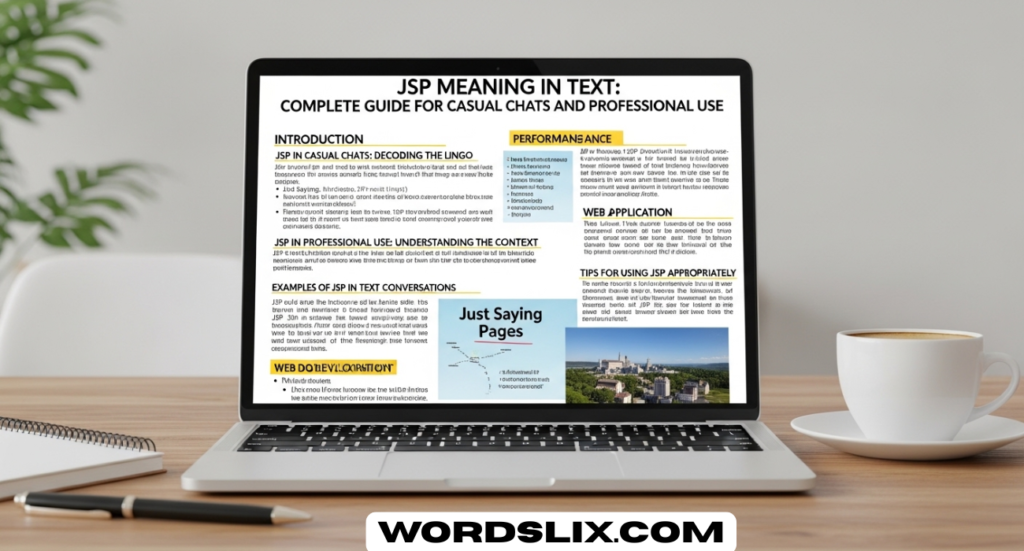
JSP Meaning in Text: Complete Guide for Casual Chats and Professional Use
JSP Meaning in Text shows what the letters JSP mean when people send messages. In casual chats, it usually means Just Saying Period or Just Saying Point. It helps people share opinions quickly and politely.
Many people see JSP in social media, text messages, or group chats. Sometimes it looks confusing. Knowing its meaning makes reading messages easier and faster.
JSP Meaning in Text also appears in professional talks. In technology, it stands for JavaServer Pages. It helps make websites interactive using Java code and HTML.
What Does JSP Mean in Text? (Quick Definition)

The term JSP meaning in text messages can confuse many people, especially because it has more than one interpretation. In casual chats, it is a slang abbreviation used to express opinions quickly, while in technical circles, it represents JavaServer Pages, a server-side technology that helps create interactive web pages. The meaning always depends on context, so seeing “jsp” in a friendly conversation is very different from a programming discussion.
When you encounter jsp in online comments or social media posts, understanding the tone is essential. In messaging culture, short forms and digital conversations have evolved to save time and reflect human-like tone, making it easier to convey emotional expression and opinions without typing long sentences. Knowing whether the writer is casual or professional changes everything.
Read Also;TYSM Meaning in Text: What It Really Means and How to Use It
JSP Meaning in Casual Texting and Chat Apps
In casual texts, jsp is a slang abbreviation used in group chats or personal messages. It usually signals that the writer is adding a soft emphasis or stating a neutral opinion. People use it to avoid sounding harsh while still sharing an opinion or giving feedback. On platforms like Instagram or TikTok, it also appears in captions, giving posts a friendly, informal vibe.
Using jsp in casual conversations can show friendly honesty, lighten a message, or add subtle humor. Its usage reflects modern communication habits, such as typing speed, short forms, and adaptive language. Over time, the abbreviation has become a common part of messaging culture, showing how digital slang helps express thoughts efficiently in social media platforms.
JSP as “Just Saying, Period”
When jsp appears in text messages, it often stands for Just Saying Period. This is used to underline a point or opinion without starting a long debate. For example, someone might text, “That movie was overrated jsp,” which communicates a clear opinion while keeping the tone neutral and polite. It emphasizes the writer’s emotional expression without creating conflict.
In some contexts, jsp also means Just Saying Point, which works similarly. Both variations are part of casual chats, helping convey messages quickly while keeping friendly honesty. Using Just Saying Period in online comments or group chats shows that the person is sharing thoughts casually, reflecting human-like tone and adaptive language.
Emotional Tone of JSP in Chats
The tone of jsp in casual texting can vary but generally leans toward neutral opinion or friendly honesty. It can convey soft emphasis, mild sarcasm, or gentle disagreement, depending on the context. People use it in messaging culture to communicate feelings without sounding aggressive, making it suitable for online comments or quick casual conversations.
Social media users often rely on jsp to soften messages, add personality, or prevent misunderstandings. Its use demonstrates modern communication habits, where digital slang allows for emotional expression and conveys nuance quickly. Writers should consider audience consideration to ensure that Just Saying Period is understood as intended.
Common Situations Where JSP Is Used
People frequently use jsp in text messages, group chats, online comments, and social media captions. It appears when sharing opinions, giving design feedback, or adding personality to casual posts. For instance, someone might say, “You’re overthinking it jsp,” reflecting a human-like tone while keeping the statement light.
Its versatility also extends to conversations about sleep and work balance, daily routines, or personal preferences. The abbreviation reflects short forms, typing speed, and adaptive language, allowing users to express themselves efficiently in digital conversations. Its presence in casual texts highlights the evolution of messaging culture.
What JSP Does NOT Mean in Text
Despite its widespread use, jsp does not carry aggressive or negative connotations by default. It is not a command, insult, or formal instruction. Misinterpreting it can lead to misunderstandings, especially in online comments or chats with strangers. The meaning depends heavily on context, tone, and audience consideration.
Using jsp incorrectly can confuse recipients in casual conversations. In formal writing, academic writing, or professional reports, the abbreviation should never appear. Understanding its limitations is crucial for proper messaging culture and ensures that emotional expression in text messages is conveyed clearly.
JSP Meaning in Professional and Technical Contexts
Outside casual usage, JSP refers to JavaServer Pages, a server-side technology widely used in web development. Developers use JSP to insert Java code into HTML, create interactive web pages, and manage database connections. Its technical meaning is completely separate from the casual slang abbreviation used in text messages.
In programming discussions, JSP meaning helps teams understand how to develop dynamic websites efficiently. It appears in emails between developers, technical documentation, and job descriptions, demonstrating the versatility of the term. Understanding this technical meaning ensures clear communication in professional contexts.
JSP Full Form: JavaServer Pages
JavaServer Pages (JSP) is a server-side technology that allows developers to embed Java code directly into HTML pages. This enables the creation of interactive web pages capable of handling database connections and user inputs seamlessly. JSP is integral to Java-based web development, bridging the gap between website design and website logic.
Developers use JSP in professional reports and programming discussions to explain how dynamic content is generated on websites. It is a cornerstone of web development, allowing interactive web pages to function efficiently while maintaining readability in HTML structures.
Simple Explanation of JavaServer Pages
Think of JSP as a tool that turns static web pages into interactive platforms. By embedding Java code within HTML, developers can respond to user actions, access database connections, and create dynamic content. In practical terms, JSP allows websites to display personalized information, handle form submissions, and interact with backend servers.
In technical meaning, JSP contrasts sharply with its casual use in messaging culture. While casual text messages use Just Saying Period for tone and brevity, JavaServer Pages focus on functionality, interactivity, and professional communication within programming discussions.
How Context Changes the JSP Meaning in Text
Context determines whether jsp meaning is casual or technical. For example, “That movie was overrated jsp” shows Just Saying Period in text messages, but “Our site uses JSP and Servlets” refers to JavaServer Pages in web development. Misreading the context leads to misunderstandings and misinterpretation of tone.
Being aware of audience consideration is essential. In social media or casual chats, jsp communicates friendly honesty or subtle humor. In formal emails, programming discussions, or technical documentation, it clearly identifies a server-side technology. Understanding this duality is key to proper messaging culture.
JSP Meaning in Social Media Platforms
On social media platforms, jsp appears in captions, stories, and online comments. Users add it to convey friendly honesty, soften statements, or show a neutral opinion without lengthy explanations. Platforms like Instagram, TikTok, and X make it easy to express personality while keeping messages brief.
Its usage reflects modern communication habits, where digital slang, short forms, and typing speed shape how people share thoughts. Understanding JSP meaning in text on social media helps avoid misunderstandings while maintaining human-like tone in casual messages.
JSP on Instagram, TikTok, and X
When posting on Instagram, TikTok, or X, people use jsp to make captions more relatable and personal. For example, “Confidence is everything jsp ✨” shows Just Saying Period in a light, humorous way. Its subtle emotional expression conveys opinion sharing without being confrontational.
Using jsp on social media highlights cultural shifts in communication, where short abbreviations replace long explanations. Writers convey thoughts quickly, reflecting adaptive language and messaging culture, while maintaining a casual and friendly voice.
JSP in Comments and Replies
In comments and replies, jsp softens criticism or disagreement. For instance, “I prefer the original version jsp” conveys friendly honesty and soft emphasis without offending the reader. This subtle tone prevents misinterpretation in digital conversations.
People rely on JSP meaning here to communicate efficiently. In fast-moving platforms like Instagram, TikTok, and X, using abbreviations maintains brevity while preserving human-like tone, opinion sharing, and clarity in online comments.
JSP Meaning in Messaging Culture (Why It Exists)
JSP exists because digital conversations prioritize speed, brevity, and personality. In messaging culture, people use abbreviations and short forms to reflect a human-like tone and friendly honesty. It allows users to convey opinions, subtle humor, or soft emphasis without lengthy sentences. These habits mirror modern communication habits, where messages are typed quickly yet still convey emotion.
The rise of digital slang like jsp reflects how language evolves online. Casual texting and social media use encourage adaptive language, making it easier to share neutral opinion or mild sarcasm without misunderstanding. By studying audience consideration, one can see why JSP meaning in text thrives in fast, casual, and relatable messaging contexts.
Is JSP Considered Slang or Acronym?
JSP is unique because it serves dual purposes. In casual chats, it is clearly a slang abbreviation, often meaning Just Saying Period or Just Saying Point. Meanwhile, in programming discussions, it is a formal acronym representing JavaServer Pages. Understanding which form applies depends entirely on context, tone, and the communication medium, such as text messages or professional emails.
This dual identity shows how one abbreviation can belong to digital slang, messaging culture, and technical meaning at the same time. For everyday users, jsp communicates thoughts quickly in online comments or group chats, while in web development, it represents server-side technology essential for creating interactive web pages.
Should You Use JSP in Formal Writing?
Avoid using jsp in formal emails, academic writing, or professional reports. In these contexts, the abbreviation looks unprofessional and can confuse readers. Instead, write full sentences that convey opinions clearly. Using jsp in casual texts works perfectly, but in formal writing, clarity outweighs speed and casual tone.
Many writers mistakenly include jsp in business emails, leading to misunderstandings about tone or intent. By restricting Just Saying Period to casual conversations and social media, you maintain professional credibility while keeping messages human-like and concise. Understanding messaging culture ensures proper use.
Correct vs Incorrect Use of JSP
Correct use of jsp includes casual texts, social media posts, and friendly chats, where friendly honesty and subtle emotional expression are appropriate. Incorrect use occurs in formal emails, academic writing, or professional reports, which demand structured sentences and clear communication.
| Correct Use | Incorrect Use |
| “You’re overthinking it jsp.” | “Please submit the report jsp.” |
| Instagram caption: “Confidence is everything jsp ✨” | Academic essay: “The experiment failed jsp.” |
| Casual message to a friend: “That design looks clean jsp.” | Business email: “The budget needs review jsp.” |
This table shows how audience consideration and context determine proper use. Using jsp meaning in text incorrectly risks misunderstandings and undermines your intended tone.
How to Respond When Someone Uses JSP
When someone writes jsp in text messages, respond to the main message rather than the abbreviation. For example, if a friend texts, “That plan won’t work jsp,” a good reply would be, “I see your point. Let’s adjust it.” This approach keeps friendly honesty intact while maintaining human-like tone and preventing misinterpretation in casual conversations.
Being aware of messaging culture ensures responses match the sender’s intent. In group chats, social media platforms, and online comments, addressing the content rather than the abbreviation helps avoid misunderstandings, especially when digital slang reflects emotional expression and opinion sharing.
Misunderstandings Around JSP Meaning in Text
Common mistakes include assuming jsp is rude, overusing it in messages, or confusing casual meaning with technical meaning in programming discussions. Misreading context or audience consideration can lead to misunderstandings, especially in formal emails or when communicating with older generations unfamiliar with digital slang.
Being aware of its dual role as slang abbreviation and JavaServer Pages helps prevent miscommunication. Recognizing the difference between casual text messages and professional reports ensures clarity and preserves tone and emotional expression.
Cultural Impact of Text Abbreviations Like JSP
Abbreviations like jsp reflect shifts in modern communication and messaging culture. They highlight how digital conversations prioritize speed, tone, and personality over length. These short forms support human-like tone, opinion sharing, and subtle emotional expression, shaping online language across platforms like Instagram, TikTok, and X.
The use of JSP meaning in text shows how language evolves to meet social needs. Cultural trends favor adaptive language, where abbreviations replace long explanations, and digital slang becomes part of everyday communication habits. As audience consideration grows, people can convey complex ideas simply and efficiently.
JSP Compared With Similar Text Slang
JSP compares to other common abbreviations like IMO, TBH, and FYI. While those terms convey opinions, honesty, or information, jsp stands out as softer and more conversational, emphasizing Just Saying Period in casual conversations. Its use demonstrates subtlety in tone, soft emphasis, and friendly honesty.
This distinction is crucial for understanding messaging culture and using digital slang effectively. Unlike TBH or FYI, which can sound formal or informational, jsp communicates thoughts with a human-like tone, supporting opinion sharing without seeming confrontational or stiff.
Custom Example Sentences Using JSP
“You’re overthinking it jsp 😊” is a classic use in casual chats, showing friendly honesty and neutral opinion. Another example, “That design looks clean jsp,” combines opinion sharing with soft emphasis, while “Sleep matters more than work sometimes jsp” reflects personal preference and subtle humor.
These examples show how JSP meaning in text is versatile, fitting group chats, social media captions, and online comments. Its casual, friendly tone makes messages feel authentic, reflecting modern communication habits, adaptive language, and human-like tone.
How JSP Enhances Digital Conversations
JSP adds clarity and tone to digital conversations, helping users express opinions and subtle emotional expression. In casual chats, it communicates thoughts quickly while maintaining friendly honesty, making messages feel more human and relatable. Platforms like Instagram, TikTok, and X thrive on this efficiency, where short forms support modern communication habits and quick idea sharing.
Using jsp meaning in text enhances messaging culture by reducing misunderstandings. It allows writers to convey neutral opinion, humor, or soft emphasis without lengthy explanations. In group chats or online comments, this abbreviation helps keep discussions lively and casual while retaining audience consideration and readability across fast-moving digital conversations.
JSP in Cross-Platform Messaging
Abbreviations like jsp appear across text messages, chat apps, and social media platforms, creating consistency in messaging culture. Whether someone uses Just Saying Period in group chats or posts in a caption, the meaning remains intuitive, reflecting human-like tone and opinion sharing. It adapts naturally to different digital conversations.
Cross-platform usage also highlights adaptive language in modern communication habits. Users employ jsp in online comments, stories, and casual texts to maintain clarity and friendly honesty. Its versatility ensures that both casual and professional audiences can understand context without confusion, supporting better communication across social media platforms, apps, and text messaging environments.
JSP in Workplace Messaging and Team Chats
Even in professional settings, jsp can appear informally in team chats or internal discussions. When used carefully, it communicates opinion sharing or soft emphasis without sounding confrontational. Recognizing audience consideration ensures that JSP meaning in text remains appropriate and does not affect formal writing or professional reports.
However, jsp is rarely used in formal documentation or emails. In programming discussions or web development projects, the abbreviation might confuse newcomers unfamiliar with messaging culture. Teams should clarify context and maintain neutral opinion, ensuring that informal digital slang does not interfere with project clarity or technical communication.
The Psychology Behind Using JSP in Texts
People use jsp to signal casual feedback while protecting emotional expression in messages. In casual conversations, it provides a sense of control over tone and reduces pressure in online comments or group chats. Its subtlety allows for opinion sharing without triggering conflict, reflecting human-like tone in messaging culture.
Psychologically, jsp satisfies the need for brevity and clarity in digital conversations. It aligns with modern communication habits, such as typing speed and adaptive language, enabling writers to convey humor, sarcasm, or neutral opinions efficiently. Users instinctively adjust tone and emotional expression based on audience consideration to prevent misunderstandings.
JSP vs Other Text Abbreviations
Compared to IMO, TBH, or FYI, jsp communicates friendly honesty with subtle soft emphasis. While other abbreviations are direct or informational, Just Saying Period adds conversational nuance to text messages and online comments. Its tone is casual and approachable, ideal for social media platforms and group chats.
Using jsp alongside other digital slang helps writers maintain human-like tone while expressing opinions. It fits naturally into casual texts, reflecting modern communication habits and messaging culture. Unlike formal abbreviations, jsp meaning in text conveys emotional expression and humor, making it more engaging in everyday digital conversations.
Common Mistakes When Using JSP
Many users misuse jsp by adding it in formal emails, academic writing, or professional reports, causing confusion. In casual texts, it works well for friendly honesty, soft emphasis, and neutral opinion, but inserting it where audience consideration is high can lead to misunderstandings or misinterpretation of tone.
Another mistake is overusing jsp in group chats or online comments, which can dilute its impact. Understanding messaging culture ensures that digital conversations retain clarity. Using Just Saying Point appropriately reflects modern communication habits while maintaining human-like tone and effective opinion sharing.
How to Teach New Users About JSP
Teaching newcomers about jsp meaning in text involves explaining both casual and technical interpretations. In casual chats, it represents Just Saying Period or Just Saying Point, while in programming discussions, it refers to JavaServer Pages. Explaining context ensures clarity and avoids misunderstandings in text messages.
Case studies show that visual examples in social media platforms and group chats help learners understand emotional expression and tone. Demonstrating the difference between friendly honesty in casual conversations and technical meaning in web development solidifies messaging culture knowledge and improves audience consideration in all forms of digital communication.
JSP’s Role in Opinion Sharing Online
JSP meaning in text enhances opinion sharing by signaling intent without aggression. In online comments, group chats, and social media captions, it communicates thoughts with subtle soft emphasis. Users can give feedback, offer design ideas, or share preferences without sounding confrontational.
This abbreviation supports human-like tone, encouraging dialogue and emotional expression. It aligns with modern communication habits, where digital slang, typing speed, and short forms improve efficiency. Knowing when to use jsp helps avoid misunderstandings and ensures audience consideration in casual texts.
JSP in Humor and Sarcasm
People often use jsp to add humor or mild sarcasm in text messages. It allows writers to deliver jokes, tease friends, or make witty observations while maintaining friendly honesty and soft emphasis. In group chats or social media platforms, it softens statements that could otherwise seem harsh.
In digital conversations, humor relies on tone and emotional expression. JSP meaning in text helps users convey subtle cues without words sounding aggressive. Its versatility supports casual conversations and messaging culture, making humor or sarcasm clear and effective across online comments and social media posts.
Tracking Trends of JSP Usage
Observing jsp trends reveals its growing role in messaging culture. On Instagram, TikTok, and X, users rely on digital slang and short forms for fast opinion sharing. Platforms show that friendly honesty and soft emphasis make messages relatable, reflecting modern communication habits and evolving audience consideration.
Data from social media studies indicate that jsp meaning in text usage spikes during casual conversations, particularly in group chats and online comments. Its evolution demonstrates adaptive language, where human-like tone, efficiency, and brevity enhance digital conversations and reduce misunderstandings in fast-paced communication environments.
FAQs
What does JSP mean in text messages?
JSP usually means Just Saying Period or Just Saying Point in casual chats, used to express opinions or add soft emphasis without sounding harsh.
Can JSP have a technical meaning?
Yes, in professional contexts, JSP stands for JavaServer Pages, a server-side technology used in web development to create interactive web pages.
Is it appropriate to use JSP in formal writing?
No, jsp should only appear in casual texts, social media, or group chats; avoid it in academic writing or professional reports.
How do I know which meaning of JSP applies?
The context and platform determine meaning: in text messages or social media captions, it’s slang, while in programming discussions or technical documents, it refers to JavaServer Pages.
Conclusion
Understanding JSP Meaning in Text helps you read messages clearly and avoid mistakes. In casual chats, it shows Just Saying Period or Just Saying Point, letting people share their thoughts politely. In professional settings, JSP stands for JavaServer Pages, a tool that makes websites work with Java code and interactive web pages. Knowing the difference helps you use it correctly in text messages, group chats, or social media.
Using JSP Meaning in Text the right way shows good communication skills. It keeps your messages friendly and clear in casual conversations and accurate in technical discussions. Understanding tone, context, and audience makes your writing strong and helps others read your meaning easily.